The process of transferring a car's name is actually quite easy. However, the completeness and conformity of the documents with the vehicle you own are the main requirements for a smooth process.
Usually, used car owners only realize the importance of transferring the name early on when they actually start the process. Problems arise, such as having to withdraw files (cabut berkas) at the Samsat where the documents were originally issued, to additional costs because the vehicle tax turns out to have been in arrears for a long time.
Transferring vehicle ownership is not just about changing the name on the STNK and BPKB. This process is directly related to the legality of vehicle ownership, ease of paying taxes, arranging insurance, and handling electronic traffic fines (ETLE).
Therefore, if you are planning to buy or already own a used car, this article will help you understand the latest 2026 car name transfer process.
This article will comprehensively discuss:
- The latest 2026 car name transfer requirements
- Car name transfer costs
- Whether the previous owner's KTP is required
- Whether you have to wait for a license plate change
- The processing time for STNK and BPKB
- Solutions if there are document issues
Let's dive right in.
Why is Transferring a Car's Name Important?
Transferring the car's name immediately becomes important when you later want to:
- Claim insurance
- Resell the car
- Mutate the vehicle (transfer registration to another region)
- Report a lost STNK and/or BPKB
A real example that often happens is wanting to report a lost STNK, but the car is still under the previous owner's name. If you had transferred the car's name when you first bought it, the process of reporting the loss would be much easier compared to if the car was still under the previous owner's name.
Therefore, you should transfer the vehicle's name immediately after purchasing a used car.
What Are the Requirements for Transferring a Car's Name?
We have summarized the car name transfer requirements in a table to make it easier for you to remember and prepare them.
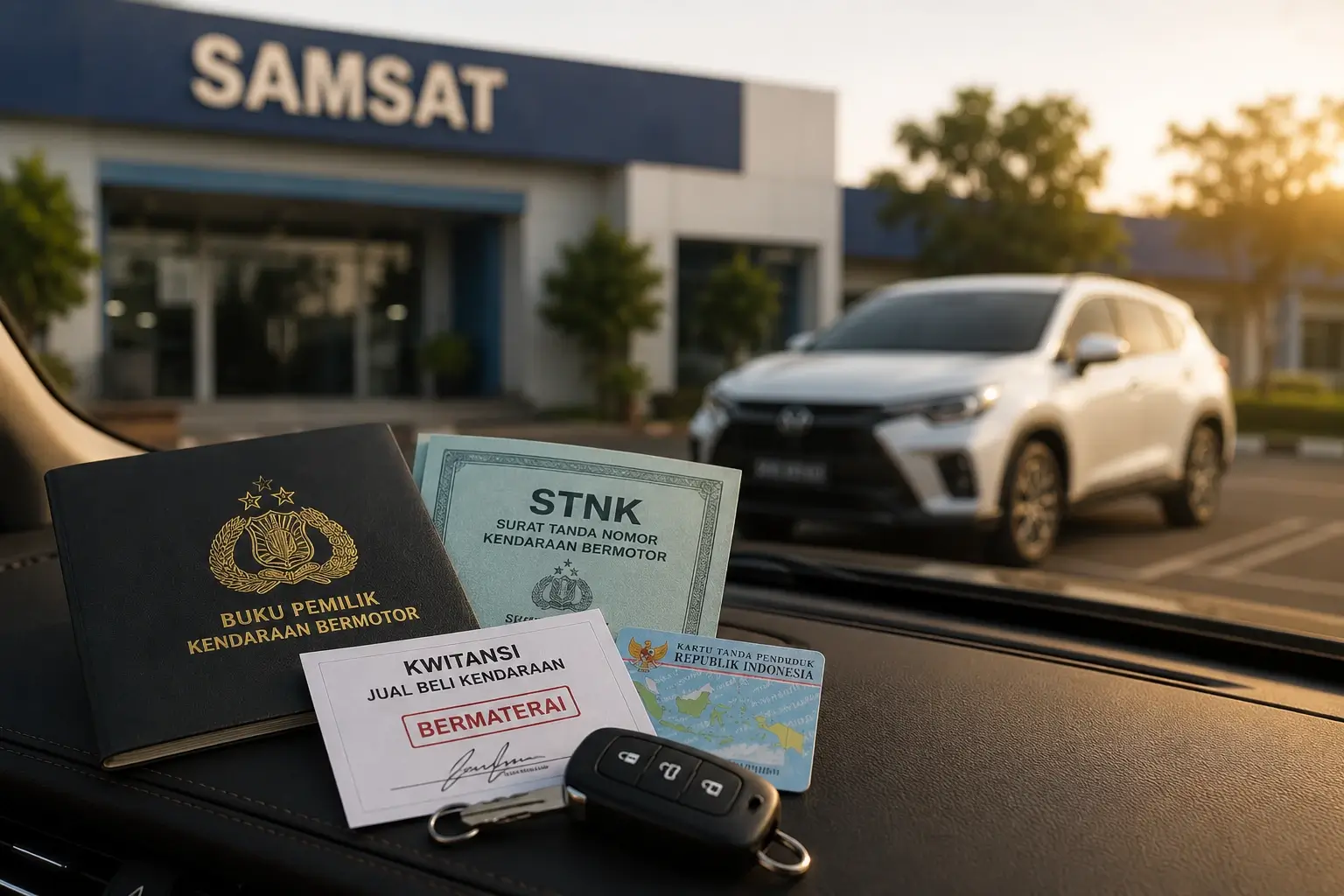
Documents usually requested by Samsat include:
| Document | Description |
| STNK | Original and 3 photocopies submitted during registration |
| BPKB | Original and submitted when exchanging for a new BPKB |
| New Owner's KTP | Original and 3 photocopies (prepare 5 copies just in case) |
| Sales Receipt | Stamped + Previous owner's signature |
| Vehicle Physical Check Results | Conducted at Samsat |
A physical vehicle check is conducted to match the engine number and chassis number with the vehicle data on the STNK and BPKB.
If the vehicle originates from a different region, the process usually begins with mutation or withdrawing files at the Samsat where the documents were initially issued.
Since Samsat's administrative policies can vary slightly in each region, you should still check the latest information through the official Samsat website in your respective region.
Does Transferring a Car's Name Require the Previous Owner's KTP?
The car name transfer process currently does not mandatory require the original KTP of the previous owner as long as the vehicle documents are complete and a sales receipt is available.
This means the new owner can still process the name transfer using their own personal identity.
However, in practice, a photocopy of the previous owner's KTP is still highly recommended.
This is important in case issues arise, such as:
- Vehicle data is not synchronized
- There are old tax arrears
- Inter-regional mutation processes
- Vehicle data verification
Therefore, when buying a used car, try to ask for:
- A photocopy of the previous owner's KTP
- A stamped sales receipt
- Original STNK
- Original BPKB
Do not buy a vehicle based solely on its physical condition without ensuring the legality of the documents.
How Much Does It Cost to Transfer a Car's Name?
Starting in 2025, the Motor Vehicle Ownership Transfer Fee (BBNKB) for used vehicles has been abolished based on the Law on Financial Relations between the Central Government and Regional Governments. This means used car owners are no longer subject to the BBNKB tax as before.
However, the name transfer process still requires other administrative fees. Prepare at least Rp500,000 in cash just in case, as some Samsat counters are not equipped for cashless payments.
Estimated 2026 Car Name Transfer Costs:
| Component | Estimated Cost |
| Issuance of new STNK | Rp200,000 |
| Issuance of new BPKB | Rp375,000 |
| License Plate / TNKB | Rp100,000 |
| SWDKLLJ (Mandatory Traffic Accident Insurance) | Rp143,000 |
| Annual Car Tax | Varies by vehicle |
The total cost amount can vary depending on:
- Vehicle tax value
- Samsat region
- Any tax arrears
- Inter-provincial mutation process
Do You Have to Wait for a License Plate Change to Transfer the Name?
You don't have to. You can still transfer the name without waiting for the license plate period to expire or during the five-year tax renewal.
If the name transfer is done before the license plate change period, usually:
- Ownership data on the STNK and BPKB can still be updated.
- The license plate replacement follows the 5-year tax schedule.
Therefore, you don't need to wait for the plate to expire to process the name transfer. In fact, the sooner the name transfer is done, the lower the risk of administrative problems in the future.
How Long Does the Car STNK and BPKB Name Transfer Process Take?
The length of the vehicle name transfer process depends on the condition of the documents and the queue at Samsat. However, in general, the estimates are as follows.
Estimated Car Name Transfer Processing Time:
| Stage | Estimated Time |
| Vehicle physical check | 30 - 60 minutes |
| Document verification | 1 - 2 hours |
| Printing License Plate | 10 - 20 minutes |
| New STNK completed | Same day / 1 working day (depending on STNK paper availability at Samsat) |
| New BPKB completed | 1 - 2 months (depending on new BPKB availability at Samsat) |
You will be given a receipt or proof that your STNK or BPKB is new, which serves as proof for collection on the date specified by Samsat. So keep that receipt safe and don't lose it.
If the vehicle has to undergo an inter-provincial mutation or file withdrawal, the process usually takes longer. Because of this, many vehicle owners choose to arrive early in the morning so the administrative process finishes faster.
How to Transfer a Car's Name at Samsat
Generally, the process of transferring a car's name involves several steps.
1. Go to Samsat and Register
Before going to Samsat and registering, make sure you have prepared the requirements we mentioned in the car name change requirements table.
Once all documents are ready, you must then go to Samsat, bringing the vehicle whose name is to be transferred.
Prepare the original and photocopies of your KTP, the original and photocopies of the STNK, the sales receipt, and then ask for a red folder to indicate that you are processing a car name transfer.
After everything is put into one folder and checked by the officer, you will receive a registration form to fill out yourself. You will be asked to fill in your full name, full address, vehicle type, vehicle manufacturing year, chassis number, and engine number.
Tip: Bring your own pen because sometimes Samsat does not provide pens for filling out registration forms.
2. Conduct a Physical Car Check and Verify Vehicle Data
After registering, the officer will direct you to continue with the vehicle physical check process. The car physical check process is completely free of charge.
The officer will rub (gesek) the chassis and engine numbers onto the registration paper and match them with your documents.
Once everything matches, you will be directed to the verification counter to check the compatibility of your car's chassis and engine numbers.
3. Go to the Archive Warehouse and Get a Queue Number
After the physical check and verification process is complete, the officer will direct you to the archive warehouse to get a queue number.
After getting the queue number, the officer will direct you to the counter for purchasing a new BPKB.
4. Pay for the New BPKB
You will be asked to pay Rp375,000 for the issuance of a new BPKB. Usually, this counter does not have cashless payment facilities. So, you should have prepared a certain amount of cash to pay at this counter.
After paying for the new BPKB, you will receive a BPKB payment receipt, which is usually accompanied by the new license plate number.
5. Pay for STNK and Vehicle Tax
After paying for the new BPKB, you will be directed to the counter for the new STNK and vehicle tax payments. This counter usually provides cashless payment options.
At this counter, you will receive a receipt as proof of settling your payment obligations.
6. Print the New License Plate
After obtaining the payment settlement receipt, you will be asked to photocopy your KTP and the receipt three times to submit to the counter for collecting the new STNK and BPKB.
But before that, the officer will direct you to the counter for collecting the new license plate simply by presenting the payment settlement receipt.
7. Collect the New STNK and BPKB
After getting the new license plate, the officer will direct you to the counter for collecting the new STNK and BPKB.
The new STNK is usually available on the same day, so you can take it right away. But usually, you have to wait for the BPKB to become available. You will receive a photocopy of the new STNK stamped by the officer as proof to collect the BPKB on the date determined by the officer. Keep that proof safe and don't lose it.
Checklist Before Going to Samsat
To speed up the process, here is a checklist you can use.
- [ ] Original STNK and photocopies
- [ ] Original BPKB and photocopies
- [ ] Original KTP of the new owner
- [ ] Stamped sales receipt signed by the previous owner
- [ ] Vehicle brought in for physical check
- [ ] Pen
- [ ] Mineral water
We hope a simple checklist like this can help you be better prepared to process the name transfer and avoid requeuing due to incomplete documents.
Common Issues During Car Name Transfers
In practice, not every name transfer process goes smoothly. Here are some of the most common issues that occur during the car name transfer process.
- Car Name Transfer Without Previous Owner's KTP
- It can still be done as long as the vehicle documents are complete and there is a sales receipt. However, the name transfer process can become more difficult if there are problems with the vehicle data.
- Transferring a Car with Expired Tax
- Usually, tax arrears must be settled before the name transfer process can continue. The longer the tax has been expired, the larger the penalty usually is.
- Transferring a Car from a Different Province
- The vehicle needs to undergo a mutation or file withdrawal from the original Samsat. This process usually takes longer than a name transfer within the same region.
- Transferring a Financed Car
- If the BPKB is still held by the leasing company, the name transfer process cannot be fully completed until the installments are paid off. Therefore, it's important to check the vehicle's status before buying a used car.
Common Mistakes that Cause Name Transfer Problems
Many used car buyers focus too much on the physical condition of the vehicle but forget to check the legal documents of the car they are about to buy.
Here are some of the most common mistakes:
- Chassis number does not match documents
- Sales receipt is not stamped
- Fake or problematic BPKB
- Vehicle tax has been expired for too long
- The vehicle is still under a lease
- Seller's identity is unclear
Therefore, don't be easily tempted by low prices without thoroughly checking the vehicle's status.
Conclusion
Transferring a car's name should not be considered a mere formality after buying a used car. Once the vehicle is registered under the new owner's identity, all administrative processes become much easier.
You no longer need to borrow the previous owner's identity when paying taxes. The risk of issues with electronic traffic fines (ETLE) and vehicle ownership also becomes smaller.
Furthermore, a car registered under your own name is usually easier to resell because potential buyers feel safer about the vehicle's legality.
In general, the latest 2026 car name transfer requirements are quite simple as long as the vehicle documents are complete. You only need to prepare the STNK, BPKB, the new owner's KTP, a stamped sales receipt, and perform a physical vehicle check at Samsat.
Also, you don't need to wait for a license plate change to transfer the name. The process can be done anytime after the vehicle transaction is complete. In fact, the sooner the name transfer is done, the lower the risk of administrative hurdles that might occur in the future.
The most important thing before buying a used car is ensuring the legality of the vehicle documents is truly secure and matches the car's physical condition. Don't just be tempted by cheap prices without checking the tax status, BPKB authenticity, and the conformity of the chassis and engine numbers.
With complete document preparation and a proper understanding of the process, transferring a car's name can actually be done more easily, quickly, and with minimal hurdles.
Get more tips and tricks about cars only at chery.co.id.
2026 Car Name Transfer FAQs
- Can a car name transfer be represented by someone else?
- Yes. Usually, a power of attorney (surat kuasa) and the identity of the representative are required.
- Does the car name transfer have to match the KTP address?
- Generally yes, especially if it relates to the Samsat administrative region.
- Does expired tax have to be paid first before a name transfer?
- Yes. Usually, tax arrears and penalties must be settled first.
- Can a used car without a BPKB have its name transferred?
- No. The BPKB is the main document of vehicle ownership.
- Is an inter-provincial car name transfer more expensive?
- Usually, it is more expensive because there are additional costs for mutation and file withdrawal